Size: 12 × 12 po
—
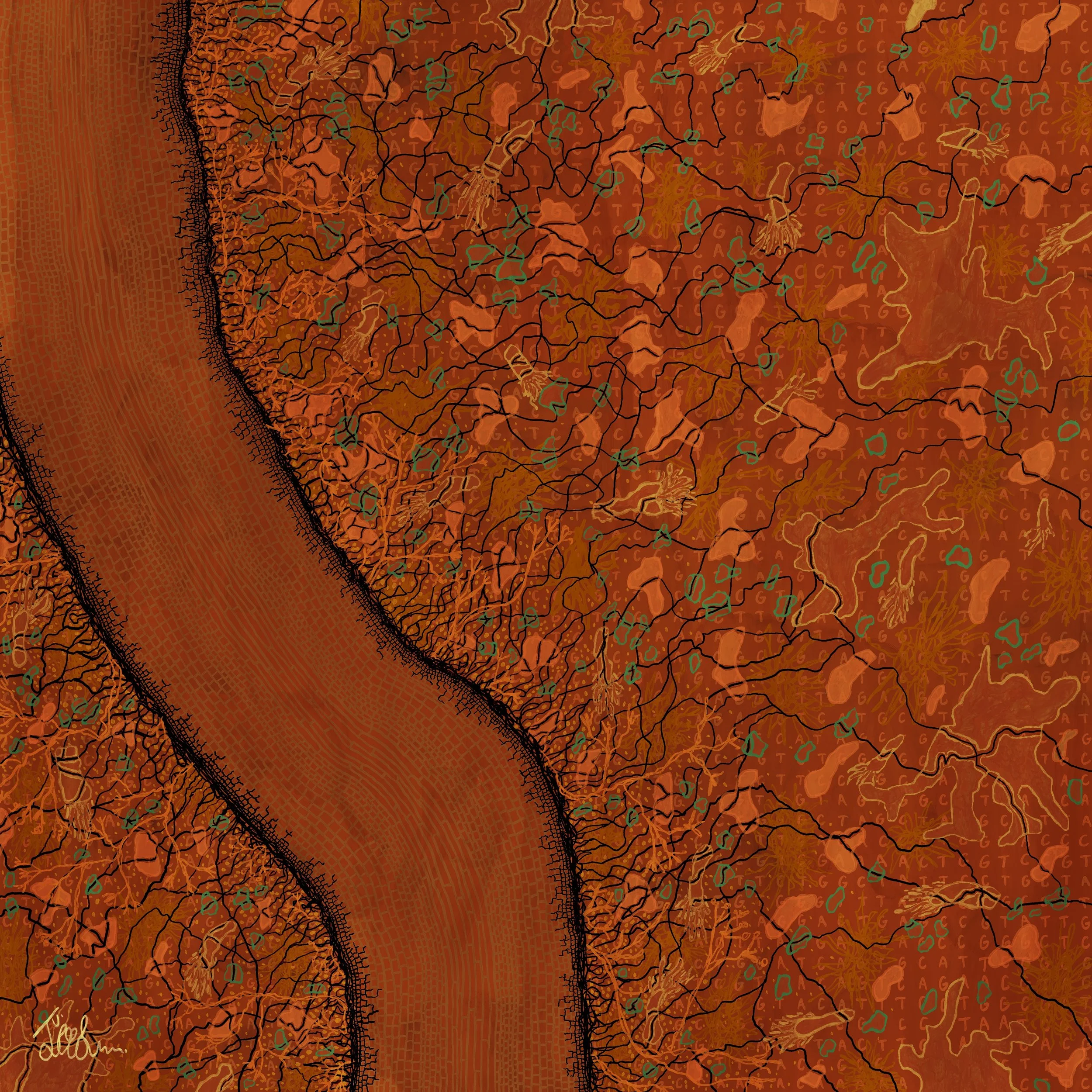
For this artwork, I drew inspiration from Christine Martineau’s research on forest soil metagenomics. My intention was to immerse the viewer in a simplified representation of a soil sample, including the rhizosphere, in order to reveal a portion of the biodiversity it contains. I also wanted to represent a form of organized chaos characteristic of soils, where a multitude of organisms and interactions coexist. The illustration features different microorganisms commonly associated with forest soils, including ectomycorrhizae, bacteria from the genera Pseudomonas and Burkholderia, fungi such as Trichoderma, as well as protozoa, together with root exudates and a fine root that evoke the close interactions between tree roots and the microbial communities of the rhizosphere. The letters T, G, C, and A are scattered throughout the artwork to evoke the building blocks of DNA and to reference metabarcoding approaches used to study the biological diversity present within a soil sample. This representation highlights the importance of molecular tools for exploring and better understanding the invisible organisms that contribute to the functioning of forest ecosystems.
Size: 12 × 12 po
—
For this artwork, I drew inspiration from Christine Martineau’s research on forest soil metagenomics. My intention was to immerse the viewer in a simplified representation of a soil sample, including the rhizosphere, in order to reveal a portion of the biodiversity it contains. I also wanted to represent a form of organized chaos characteristic of soils, where a multitude of organisms and interactions coexist. The illustration features different microorganisms commonly associated with forest soils, including ectomycorrhizae, bacteria from the genera Pseudomonas and Burkholderia, fungi such as Trichoderma, as well as protozoa, together with root exudates and a fine root that evoke the close interactions between tree roots and the microbial communities of the rhizosphere. The letters T, G, C, and A are scattered throughout the artwork to evoke the building blocks of DNA and to reference metabarcoding approaches used to study the biological diversity present within a soil sample. This representation highlights the importance of molecular tools for exploring and better understanding the invisible organisms that contribute to the functioning of forest ecosystems.